Cash Basis Accounting for Sole Traders: Cash Basis vs Traditional Accounting 2026/27
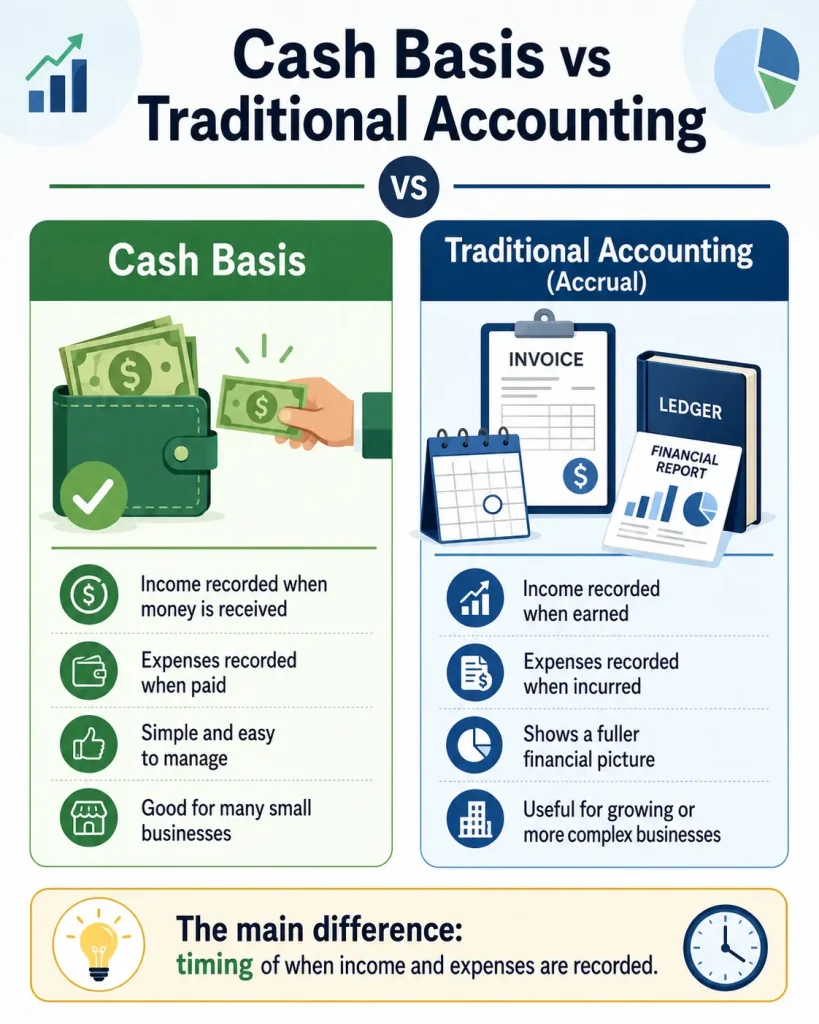
Cash basis accounting is now the standard method most eligible sole traders use to calculate their taxable business profit. Under cash basis, you normally record income when a customer pays you and claim allowable expenses when you pay them.
HMRC made cash basis the default from 6 April 2024. Eligible sole traders can still choose traditional accounting, also called accruals accounting, if that method suits their business better. HMRC also removed the previous cash-basis turnover limits from the same date.
For a freelancer, tradesperson, tutor, consultant or other straightforward business, cash basis can make record keeping much simpler. Traditional accounting may suit businesses that hold significant stock, have large unpaid invoices or supplier bills, need detailed financial reports, or plan to apply for finance.
Your choice affects when you include income and expenses in your taxable profit, so it can change which tax year includes a particular transaction.
Quick answer: how do you get a UTR number?
Cash basis accounting for a sole trader means you record income when you receive payment and claim allowable expenses when you pay them. Since 6 April 2024, HMRC has treated cash basis as the default method for most eligible sole traders, and the old turnover limits no longer apply. You can still choose traditional accounting. Traditional accounting may provide a clearer financial picture if your business holds significant stock, has substantial unpaid invoices or bills, or needs detailed accounts for lenders or management purposes.
Table of Contents
- Cash basis vs traditional accounting at a glance
- What cash basis accounting means
- How traditional accounting works
- What happens when an invoice crosses 5 April?
- Is there still a cash basis turnover limit?
- Who can use cash basis?
- How equipment and expenses work
- How stock and unpaid invoices differ
- Which accounting method should you choose?
- Can you change accounting method?
- Cash basis and Making Tax Digital
- Common mistakes
- What should you do next?
Cash Basis vs Traditional Accounting at a Glance
| Question | Cash Basis | Traditional Accounting |
|---|---|---|
| When do you record sales income? | When the customer pays you | When the income relates to the accounting period |
| When do you record an expense? | When you pay it | When the cost relates to the accounting period |
| Is it the default for eligible sole traders? | Yes, since 6 April 2024 | No, you choose it |
| Do unpaid customer invoices count immediately? | Normally no | Normally yes if they relate to that period |
| Can unpaid supplier bills affect profit? | Normally only after payment | Yes, if they relate to that period |
| How does stock affect the accounts? | Purchases generally follow payments made | The accounts consider closing stock and cost of sales |
| How complex is it? | Usually simpler | Usually more detailed |
| Can it help when applying for finance? | Sometimes | Often, because the accounts show more detail |
HMRC describes cash basis as the standard method for eligible sole traders and qualifying partnerships. Traditional accounting uses a more detailed approach that takes invoices, bills, stock and other year-end adjustments into account.
What Does Cash Basis Accounting Mean for a Sole Trader?
Cash basis focuses mainly on money that actually enters or leaves your business.
For example, imagine that a customer owes you £2,000 on 5 April but has not yet paid. Under cash basis, you would normally leave that £2,000 out of your income until you receive the payment.
The same principle applies to expenses. If a supplier sends you a bill before the end of the tax year but you pay it afterwards, you would normally claim the expense when you make the payment.
You still need accurate records. Cash basis does not mean you can rely only on your bank balance or ignore transactions paid in another way.
HMRC expects you to keep records of your business income and expenses, including payments made by cash, card, bank transfer, cheque or other methods.
Read HMRC’s cash basis guidance
How Does Traditional Accounting Work?
Traditional accounting, often called accruals accounting, looks at when income and costs relate to the business rather than simply when money moves through the bank.
Your accounts may therefore include:
- Invoices that customers have not yet paid.
- Supplier bills that you still need to pay.
- Stock held at the end of the year.
- Costs paid in advance.
- Expenses that relate to the year but have not yet been billed.
- Business assets.
- Money customers owe you.
- Money you owe suppliers.
This approach takes more work, but it can provide a clearer picture of how the business performed during a particular period.
For example, a business might complete a large project in March but receive payment in May. Traditional accounting can show the March income in the period when the business earned it rather than waiting until the customer pays.
What Happens When an Invoice Crosses 5 April?
The end of the UK tax year can make the difference between cash basis and traditional accounting particularly important.
Illustrative example:
A freelance web developer sends a customer an invoice for £4,000 on 28 March 2027.
The customer pays the invoice on 15 April 2027.
With cash basis, the developer would normally record the £4,000 when the payment arrives on 15 April. The income would therefore fall into the 2027/28 tax year.
With traditional accounting, the business would normally include the £4,000 in the period in which it earned the income. In this example, that may place it in 2026/27.
This timing difference explains why sole traders often have questions about invoices issued shortly before 5 April.
Is There Still a Cash Basis Turnover Limit?
No.
HMRC removed the old turnover limits from 6 April 2024.
Before that date, a business generally needed turnover of no more than £150,000 to enter cash basis. Previous rules could also require businesses to leave the scheme after turnover exceeded a higher limit.
Those limits no longer apply under the current rules.
HMRC also made cash basis the default method for eligible businesses from 6 April 2024.
As a result, articles that still describe the £150,000 entry limit as a current requirement now contain outdated information.
Who Can Use Cash Basis?
Most ordinary sole traders can use cash basis.
That includes many:
- Freelancers.
- Consultants.
- Tradespeople.
- Delivery drivers.
- Tutors.
- Gardeners.
- Contractors.
- Digital professionals.
- Other self-employed service providers.
However, some businesses cannot use the scheme.
For example, limited companies and limited liability partnerships cannot use the Income Tax cash basis described in this guide. HMRC also excludes certain specialist businesses and some businesses that use specific tax elections.
If your circumstances are unusual, check the current eligibility rules rather than assuming cash basis applies.
Check HMRC’s cash basis eligibility rules
How Do Expenses and Equipment Work?
Whichever accounting method you use, an expense must still meet the normal tax rules before you can deduct it from business income.
Cash basis mainly changes when you claim the cost.
If you buy an allowable day-to-day business item under cash basis, you would normally claim the expense when you pay for it.
Many items of business equipment also qualify as normal expenses under cash basis.
However, different rules apply to some purchases, including cars, land and certain other capital items. Business cars may qualify for capital allowances instead, depending on the circumstances.
Traditional accounting treats capital spending differently. Instead of deducting every equipment purchase as a normal expense, the business may need to claim capital allowances.
For more information on business costs, read Real Key Accountancy’s guide to allowable expenses for sole traders.
How Do Stock and Unpaid Invoices Differ?
Stock can make the choice between cash basis and traditional accounting more important.
Stock under cash basis
Under cash basis, the business generally follows the amount it actually pays for qualifying goods bought for resale.
Imagine that a retailer spends £20,000 on stock shortly before 5 April but sells most of those goods during the next tax year. Cash basis may show a large cost in the first year even though the related sales arrive later.
That treatment may be correct under the rules, but it can make profit figures move sharply from one year to another.
Stock under traditional accounting
Traditional accounting looks at the cost of goods sold during the accounting period.
The business also considers stock that remains unsold at the end of the year. This approach can match sales and stock costs more closely.
For that reason, HMRC identifies businesses with high stock levels as one situation where traditional accounting may make more sense.
What about unpaid customer invoices?
Cash basis normally excludes an invoice from taxable income until the customer pays it.
If the customer never pays, you usually do not need a separate deduction for a bad debt because you never included that amount in income.
Traditional accounting works differently. If you previously included the invoice in turnover and later establish that the customer will not pay, the tax rules may allow you to write off the qualifying bad debt.
Which Accounting Method Should a Sole Trader Choose?
No single method suits every business.
When cash basis may suit you
Cash basis often works well when:
- Your business has straightforward income and expenses.
- Customers usually pay you quickly.
- You hold little or no stock.
- You have few unpaid supplier bills.
- You want simpler bookkeeping.
- Your bank transactions give you a useful view of the business.
A freelance consultant who sends a small number of invoices each month and has few business assets may find cash basis practical and easy to manage.
When traditional accounting may suit you
Traditional accounting may deserve closer consideration when:
- You hold significant stock.
- Customers owe you large amounts.
- You owe substantial amounts to suppliers.
- You need detailed financial reports.
- You plan to apply for business finance.
- A lender wants accrual-based accounts.
- You need to understand debtors, creditors and stock levels.
- Your business has become more complex as it has grown.
| Business Situation | Method Worth Considering | Why |
|---|---|---|
| Freelancer paid quickly with simple costs | Cash basis | Straightforward records |
| Tradesperson with few outstanding bills | Cash basis | Income and expenses broadly follow cash |
| Retailer carrying substantial stock | Traditional accounting | Better matching of stock and sales |
| Business with large unpaid invoices and bills | Traditional accounting | Shows money owed and owing |
| Business seeking significant finance | Traditional accounting | Can provide lenders with more detail |
| Growing business needing detailed reports | Traditional accounting | Gives a broader view of performance |
A useful question to ask is:
“Do my bank transactions alone give me enough information to understand how my business is performing?”
If they do, cash basis may work well.
If they do not, traditional accounting may give you more useful information.
Can You Change From Cash Basis to Traditional Accounting?
Yes.
However, you should review the figures before switching.
Changing accounting method can create adjustments because HMRC needs to prevent income or expenses from appearing twice or disappearing from your tax calculations.
For example, you may need to review:
- Unpaid customer invoices.
- Supplier bills.
- Stock.
- Payments made in advance.
- Capital items.
- Previous capital allowance claims.
HMRC calls these transitional adjustments. In simple terms, they correct the difference between the old accounting method and the new one.
When a positive adjustment creates extra taxable income after leaving cash basis, HMRC normally spreads that income over six years, subject to the detailed rules.
An established sole trader should therefore calculate the effect before changing method rather than simply changing a software setting.
Can You Change From Traditional Accounting to Cash Basis?
Yes, provided you qualify for cash basis.
Again, you may need to adjust the figures when you switch.
For example, traditional accounts might already include income from customers who have not yet paid. Moving directly to cash basis without an adjustment could lead to the business counting that income again when the customer eventually pays.
Similar issues can arise with unpaid supplier bills, stock and advance payments.
The purpose of the adjustment is to make sure you count each item once.
Does Making Tax Digital Change Your Accounting Basis?
No.
Making Tax Digital for Income Tax does not force sole traders to use traditional accounting.
Cash basis remains the default accounting method for eligible businesses. If you choose traditional accounting, compatible software can include the required year-end adjustments, such as accruals and prepayments.
MTD for Income Tax started on 6 April 2026 for qualifying sole traders and landlords above the first qualifying-income threshold.
Under the current timetable:
- Qualifying income over £50,000 brings a taxpayer into MTD from 6 April 2026, subject to HMRC’s qualifying rules.
- Qualifying income over £30,000 brings more taxpayers into MTD from 6 April 2027.
- Qualifying income over £20,000 extends the rules further from 6 April 2028.
Qualifying income broadly means gross self-employment and property income before expenses rather than taxable profit.
If MTD applies to you, you must use compatible software and keep the required digital records.
Read Real Key Accountancy’s Making Tax Digital for Income Tax guide for more detail.
Common Cash Basis Accounting Mistakes
Using outdated turnover limits
The old £150,000 entry limit no longer applies. HMRC removed the previous cash-basis turnover limits from 6 April 2024.
Using the invoice date instead of the payment date
Under cash basis, you normally record income when you receive the money rather than when you send the invoice.
Assuming cash basis means no bookkeeping
You still need complete and accurate business records.
Treating your bank balance as your taxable profit
Money you introduce personally, drawings and other non-trading transactions can change the bank balance without changing taxable profit.
Recording only the net amount from payment platforms
A payment platform may deduct its fee before transferring money to you. Your records should still show the correct business income and any allowable processing charge.
Confusing Income Tax cash basis with VAT cash accounting
These are separate systems with different rules.
Changing methods without reviewing the adjustments
A poorly handled switch can cause you to count income or expenses twice, or leave them out completely.
Choosing a method only because of one year-end invoice
Choose an accounting method that suits the ongoing business rather than focusing on the tax timing of a single transaction.
What Should You Do Next?
For many straightforward sole traders, cash basis offers the simplest option.
Before deciding, ask yourself:
- Do I hold significant stock?
- Do customers regularly owe me large amounts?
- Do I have substantial unpaid supplier bills?
- Will I need accounts for business finance or a mortgage application?
- Would detailed information about money owed to and by the business help me?
- Do I need more detailed management accounts?
- Am I already using traditional accounting?
- Would switching create a significant tax adjustment?
If you cannot answer those questions from your existing records, focus on organising your bookkeeping first.
Real Key Accountancy’s bookkeeping guide for sole traders explains how to keep your records organised throughout the year.
Need Help Deciding Which Accounting Basis Fits Your Business?
Real Key Accountancy supports sole traders and small businesses with bookkeeping, Self Assessment, digital records and practical accounting support.
If your business has stock, overdue invoices, increasing transaction volumes or an existing set of accounts, it can make sense to review the records before changing accounting method.
Speak to Real Key Accountancy about your accounting requirements
Conclusion
For most eligible sole traders, cash basis accounting is now the default. You normally record income when customers pay you and claim allowable expenses when you pay them.
Traditional accounting remains an option. It may provide more useful information if your business has significant stock, unpaid customer invoices, supplier bills, financing requirements or more complex financial reporting needs.
Choose the method that fits how your business operates rather than the method that gives the most convenient result for one tax year.
If you plan to change accounting method, check whether HMRC’s adjustment rules affect you before making the switch.
Frequently Asked Questions
Everything you need to know about our bookkeeping services and how we can support your business.
Is cash basis accounting compulsory for sole traders?
No. HMRC treats cash basis as the default for eligible sole traders, but you can choose traditional or accruals accounting instead. Some businesses cannot use cash basis and must follow traditional accounting rules.
When did cash basis become the default?
HMRC made cash basis the default for eligible businesses from 6 April 2024, starting with the 2024/25 tax year. Before then, businesses generally had to choose to enter the cash-basis regime.
Is there still a £150,000 cash basis turnover limit?
No. HMRC removed the former £150,000 entry threshold and the related exit threshold from 6 April 2024. Eligible businesses can now use cash basis without the previous turnover ceiling.
What happens to an invoice sent before 5 April but paid afterwards?
Under cash basis, you normally record the income when the customer pays you. A payment that arrives after 5 April will therefore usually fall into the following tax year. Traditional accounting may place the income in the earlier period instead.
Does cash basis mean I only need bank statements?
No. You still need adequate business records and supporting evidence. Bank statements may not explain cash income, mixed personal and business spending, payment-platform deductions or why you incurred a particular cost.
Is cash basis better for freelancers?
It often suits freelancers with simple costs, little stock and customers who pay promptly. Cash basis can make record keeping easier because income and expenses broadly follow the movement of money.
Is traditional accounting better if I hold stock?
It may be. Traditional accounting takes closing stock and cost of sales into account, which can give a clearer picture of profit where a business buys and holds significant amounts of stock.
Can a limited company use this cash basis?
No. The Income Tax cash basis covered in this guide applies to eligible sole traders and certain partnerships. Limited companies and limited liability partnerships cannot use it.
What happens to equipment bought under cash basis?
You can deduct the cost of many qualifying items of business equipment as an ordinary expense when you pay for them. Different rules apply to cars, land and certain other capital purchases.
What happens if a customer never pays me?
Under cash basis, you normally do not include an unpaid invoice in income. If the customer never pays, you therefore usually have no separate bad-debt deduction to claim for that invoice.
Can I switch from cash basis to traditional accounting?
Yes. However, you may need to make an adjustment for items such as unpaid invoices, supplier bills, stock and advance payments. Check the figures before switching so you do not count anything twice or leave it out.
Can I switch from traditional accounting to cash basis?
Yes, if you qualify. You may need to adjust your figures to account for income and costs already included under traditional accounting.
Is cash basis the same as the VAT Cash Accounting Scheme?
No. Income Tax cash basis and VAT Cash Accounting are separate systems. Different eligibility tests and accounting rules apply to each.
Still have a question?
BOOK A FREE CONSULTATION