
The HMRC mileage allowance can help eligible self-employed drivers calculate vehicle expenses using approved flat rates. If you are a self-employed taxi, private-hire, courier or delivery driver, vehicle costs are likely to be one of your largest business expenses. Keeping an accurate mileage record can make bookkeeping simpler and help you support the figures used when your business records are prepared.
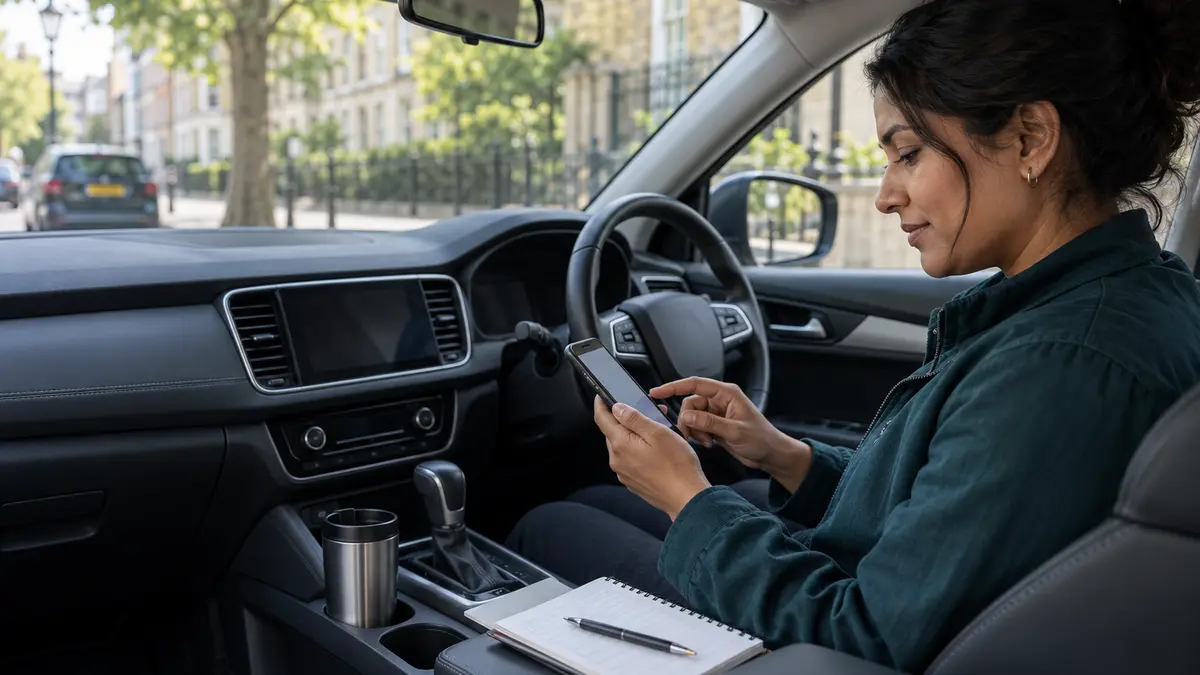
From 6 April 2026, HMRC’s simplified-expenses rate for eligible cars and goods vehicles is 55p per business mile for the first 10,000 miles in the tax year and 25p for each business mile after that. The motorcycle rate is 24p per mile. Before 6 April 2026, the first-10,000-mile rate for cars and goods vehicles was 45p.
This guide explains the 2026/27 rates, which journeys normally count as business mileage, the records drivers should keep and important restrictions for taxis and limited companies.
Driving for Uber, Bolt, private hire or deliveries?
Keeping mileage, platform statements, receipts and expenses organised can save time and make your bookkeeping records easier to manage.
- Organised income, mileage and expense records
- Regular bookkeeping updates
- Support with bookkeeping queries
Bookkeeping support is quoted according to transaction volume and agreed scope.
Calculate your business mileage
Use our free calculator to estimate an eligible mileage amount, then keep the result with your mileage log and bookkeeping records.
HMRC mileage allowance rates for 2026/27
| Vehicle | Business mileage | 2026/27 flat rate |
|---|---|---|
| Eligible cars and goods vehicles | First 10,000 business miles | 55p per mile |
| Eligible cars and goods vehicles | Above 10,000 business miles | 25p per mile |
| Motorcycles | All eligible business miles | 24p per mile |
These are HMRC simplified-expenses rates for self-employed people. Check the current official guidance on GOV.UK simplified vehicle expenses before relying on a calculation.
Worked mileage example for a delivery driver
A self-employed delivery driver records 12,000 eligible business miles during the 2026/27 tax year. Using the simplified method, the calculation would be:
- First 10,000 miles × 55p = £5,500
- Remaining 2,000 miles × 25p = £500
- Total simplified vehicle expense: £6,000
The driver should retain a journey log showing how the business mileage was calculated. The mileage amount is an expense calculation, not a separate cash payment from HMRC.
Can taxi drivers use the mileage method?
Not every taxi vehicle qualifies. GOV.UK says simplified vehicle expenses cannot be used for cars designed for commercial use, giving black cabs and hackney carriages as examples. A private-hire driver using an ordinary car may be in a different position, but eligibility depends on the vehicle and the method already used.
You also cannot use simplified mileage for a vehicle if you have already claimed capital allowances for it or included the vehicle purchase as an expense when calculating business profits. Once flat rates are used for a particular vehicle, HMRC says you must normally continue using them for as long as that vehicle remains in the business.
Drivers should check their exact circumstances with an appropriately authorised tax professional rather than assuming that every licensed vehicle qualifies.
Can delivery and courier drivers claim mileage?
A self-employed courier or delivery driver may be able to use simplified mileage for an eligible car, van or motorcycle. The journey must be for business purposes and reliable mileage records should be kept.
Examples may include travelling between delivery locations, collecting goods for delivery, travelling to a temporary business location or making a journey wholly for business. Personal journeys and the private part of mixed journeys should not be included.
Which journeys normally count as business mileage?
Business mileage is travel undertaken for the purposes of the trade. For drivers, the facts of each journey matter. A strong mileage log should explain where the journey started, where it ended, why it was necessary and how many business miles were travelled.
Ordinary travel between home and a permanent workplace is generally private commuting, while travel forming part of the business activity may be treated differently. Drivers whose home is their business base can have more complicated circumstances, so the reason for each journey should be recorded rather than labelling every mile as business mileage.
What records should taxi and delivery drivers keep?
- Date of each journey
- Starting point and destination
- Business reason for the journey
- Business miles travelled
- Vehicle used
- Odometer readings where practical
- Platform or operator statements
- Fuel, parking and toll receipts
- Evidence separating personal and business travel
A mileage-tracking application can help, but entries should still be reviewed. Automatic trackers can record private journeys, duplicate trips or miss the business purpose.
Mileage rates versus actual vehicle costs
Simplified mileage uses a flat rate instead of separately claiming the qualifying costs of buying and running the vehicle, such as fuel, insurance, repairs and servicing. Alternatively, some businesses calculate the allowable business proportion of actual vehicle costs.
The best method depends on mileage, vehicle costs, private use and the vehicle’s tax treatment. A high-mileage driver should not assume that one method will always produce the better result. Compare the permitted options before committing to a method for a vehicle.
Can parking and tolls be recorded separately?
HMRC’s guidance says other travel expenses, such as parking and public-transport journeys, may be claimed on top of simplified vehicle expenses when they are incurred wholly and exclusively for business. Penalties and fines are different and should not automatically be treated as allowable business expenses.
Keep the receipt and record the business reason so the cost can be reviewed correctly.
What about limited-company drivers?
HMRC simplified expenses are available to sole traders and eligible partnerships, not limited companies. A director or employee using a personal vehicle for qualifying business journeys may instead fall under different mileage-payment rules.
Do not apply the self-employed simplified-expenses calculation to a limited company without checking the correct treatment.
Common mileage-record mistakes
- Claiming every mile driven without separating private travel
- Using 55p for journeys made before 6 April 2026
- Applying the first-10,000-mile rate separately to each delivery platform
- Claiming simplified mileage and the same fuel, insurance or repair costs again
- Using simplified mileage after claiming capital allowances for the vehicle
- Assuming a black cab or hackney carriage automatically qualifies
- Keeping a total mileage figure without dates, destinations or business reasons
- Mixing limited-company mileage rules with sole-trader simplified expenses
A simple monthly mileage routine
- Record journeys during the working day rather than reconstructing them months later.
- Review personal and business classifications each week.
- Download statements from delivery, taxi or private-hire platforms.
- Reconcile mileage, income, fees and related expenses monthly.
- Store supporting records securely with the relevant accounting period.
- Check the correct rate for the date of travel.
Regular bookkeeping makes unusual figures easier to spot and reduces the risk of missing records at year end.
Bookkeeping support for taxi and delivery drivers
Real Key Accountancy helps sole traders organise platform income, mileage logs, receipts and expense records, with clear updates and help with bookkeeping queries.
Bookkeeping support is quoted according to transaction volume and agreed scope.
Book your free 15-minute bookkeeping check
Prefer to compare options first? View our bookkeeping packages.
Frequently asked questions
What is the HMRC mileage allowance rate from 6 April 2026?
For eligible cars and goods vehicles under the self-employed simplified-expenses method, it is 55p per mile for the first 10,000 business miles and 25p after that. Motorcycles use 24p per mile.
Can I claim fuel as well as simplified mileage?
The simplified mileage rate replaces the qualifying costs of buying and running that vehicle, including fuel. Claiming both could duplicate the same vehicle expense.
Do food-delivery miles count?
Miles travelled wholly for the delivery business may count, subject to the normal rules and reliable records. Private travel must be excluded.
Can a black-cab driver use simplified mileage?
GOV.UK specifically lists black cabs and hackney carriages as examples of cars designed for commercial use that cannot use simplified vehicle expenses.
How long should mileage records be kept?
Record-retention requirements depend on the business and filing position. Follow current HMRC requirements and keep supporting evidence for the required period.
Reviewed September 2026. This article provides general information, not personalised tax advice. Vehicle type, business structure and previous claims can change the treatment. Check current GOV.UK guidance and obtain advice from an appropriately authorised professional where needed.